CryoAnomaly

Few-Shot Cryo-EM Particle Picking via Anomaly-Guided Hard Negative Suppression

Riku Itsuji1,2 Rintaro Otsubo1,2 Ryo Fujii1,2 Xingjian Li3 Xiaolong Wu3 Hideo Saito1,2 Min Xu3
1Keio University, Yokohama, Japan 2Keio AI Research Center, Yokohama, Japan 3Carnegie Mellon University, Pittsburgh, USA
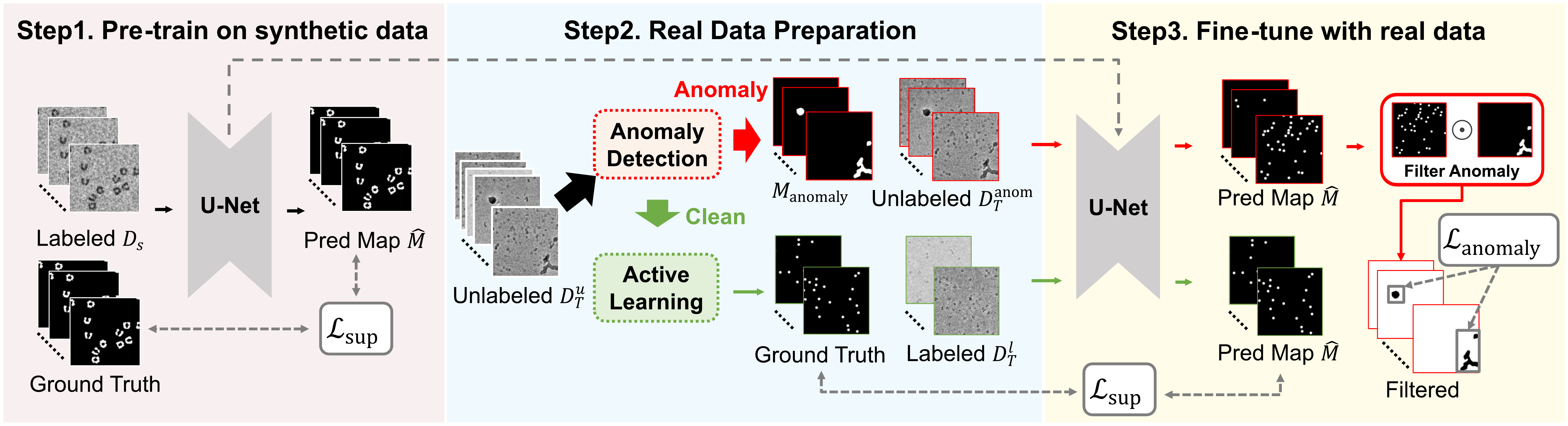
Overview of the CryoAnomaly pipeline
Overview of the CryoAnomaly pipeline. It bridges the Sim2Real gap through synthetic pre-training (Step 1), data preparation via anomaly detection and active learning (Step 2), and fine-tuning with anomaly-guided suppression (Step 3).

Abstract

Cryo-electron microscopy (cryo-EM) is crucial for analyzing 3D biological structures, in which automated particle picking is essential for the workflow. However, fully supervised methods require extensive manual annotations. While few-shot learning offers a potential solution, existing approaches struggle to handle the diverse contaminations inherent in real micrographs owing to insufficient negative supervision, resulting in false positives that degrade the quality of the 3D reconstruction. Although synthetic data provides abundant and perfect labels, their use has primarily been restricted to validating identical proteins or augmenting full-shot training, leaving the potential for few-shot adaptation to novel proteins unexplored.

In this study, we investigate the effective utilization of synthetic data for few-shot particle picking. We identify that direct transfer fails due to a “clean-vs-contaminated” Sim2Real gap. To overcome this, we propose CryoAnomaly, a framework that turns this gap into an advantage. By employing an anomaly detector trained on clean synthetic data, we identify real-world contaminants as anomalies and suppress them via a novel anomaly-guided hard negative suppression loss.

On the CryoPPP benchmark, CryoAnomaly achieves the best picking accuracy and reconstruction resolution among state-of-the-art methods in the few-shot setting. The proposed anomaly-guided loss is confirmed to be effective on datasets with diverse contamination, where reliable pseudo-anomaly masks can be generated.
Main Results

1-shot comparison on five CryoPPP datasets under the same target-domain annotation budget. Baselines are reported as mean±standard deviation; CryoAnomaly is deterministic and evaluated once. Best results in bold, second-best underlined. Resolution: 3-trial average GSFSC (Å).

Method / EMPIAR-ID 10081 10093 10345 10532 11056 AVG
Precision (↑)
crYOLO0.592±0.1850.356±0.2310.523±0.2850.262±0.1530.183±0.1610.383
Topaz0.180±0.0100.227±0.0080.056±0.0030.384±0.0280.353±0.0160.240
CryoSegNet0.601±0.0860.365±0.0540.423±0.1790.522±0.0420.576±0.0300.497
CryoFSL0.329±0.0270.181±0.0250.138±0.0240.244±0.0590.276±0.0120.234
CryoAnomaly (Ours)0.7170.3660.5260.5740.6510.567
Recall (↑)
crYOLO0.594±0.2280.199±0.2860.291±0.2420.582±0.3040.733±0.0340.480
Topaz0.922±0.1070.967±0.0300.746±0.1400.917±0.0770.795±0.1370.869
CryoSegNet0.722±0.0780.381±0.0500.512±0.1550.334±0.1700.636±0.0460.517
CryoFSL0.853±0.0830.608±0.0550.826±0.1380.664±0.0900.788±0.0310.748
CryoAnomaly (Ours)0.8480.5270.6910.4810.5680.623
F1 Score (↑)
crYOLO0.524±0.1880.116±0.0760.334±0.2510.276±0.0990.268±0.1310.304
Topaz0.300±0.0110.367±0.0100.104±0.0040.539±0.0190.485±0.0300.359
CryoSegNet0.654±0.0760.367±0.0190.415±0.1120.384±0.1260.603±0.0250.485
CryoFSL0.468±0.0190.275±0.0210.230±0.0300.346±0.0600.408±0.0120.345
CryoAnomaly (Ours)0.7770.4320.5970.5230.6070.587
Resolution (Å) (↓)
crYOLO10.57±0.0822.81±4.5855.88±39.5514.06±8.7525.83
Topaz16.89±0.2313.72±0.5617.56±0.838.26±0.0514.11
CryoSegNet9.36±0.088.58±0.0422.31±0.475.92±0.1111.54
CryoFSL8.83±0.108.65±0.0517.38±0.215.78±0.2710.16
CryoAnomaly (Ours)8.688.0616.264.859.46
# Picked
crYOLO17,585±30,45117,554±32,8161,060±93665,002±43,636138,925±37,54748,025
Topaz48,986±3,00849,051±2,06447,343±2,69756,336±6,37360,884±11,76552,520
CryoSegNet10,561±1,21412,073±3,3694,330±3,65814,091±7,42129,806±2,81714,172
CryoFSL11,935±98017,821±2,5915,286±1,39435,065±5,82335,836±2,16321,189
CryoAnomaly (Ours)10,28416,0693,24418,34323,47514,283

* 3D reconstruction parameters for EMPIAR-11056 were not available.

* crYOLO, Topaz, and CryoSegNet were originally proposed as fully supervised methods, whereas CryoFSL and CryoAnomaly are few-shot methods. We evaluate them in the common 1-shot setting for a fair comparison.

Qualitative Results

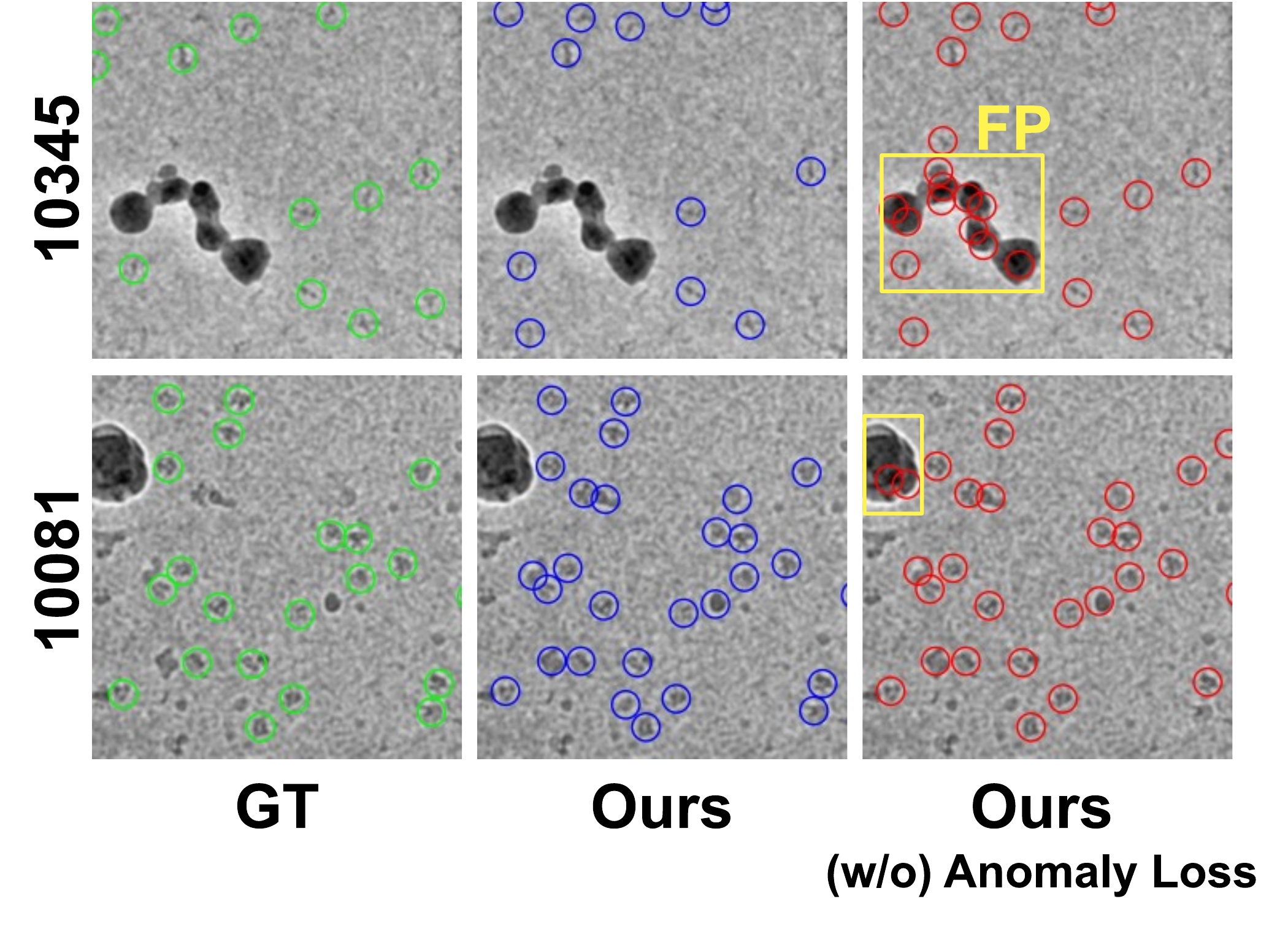
Qualitative particle-picking comparison
Qualitative comparison of particle picking with and without the anomaly-guided loss. Green, blue, and red circles denote the ground truth, our predictions, and predictions without anomaly loss, respectively. Yellow boxes highlight false positives on contaminants, which are prominent when the anomaly loss is excluded.
3D reconstruction local-resolution maps
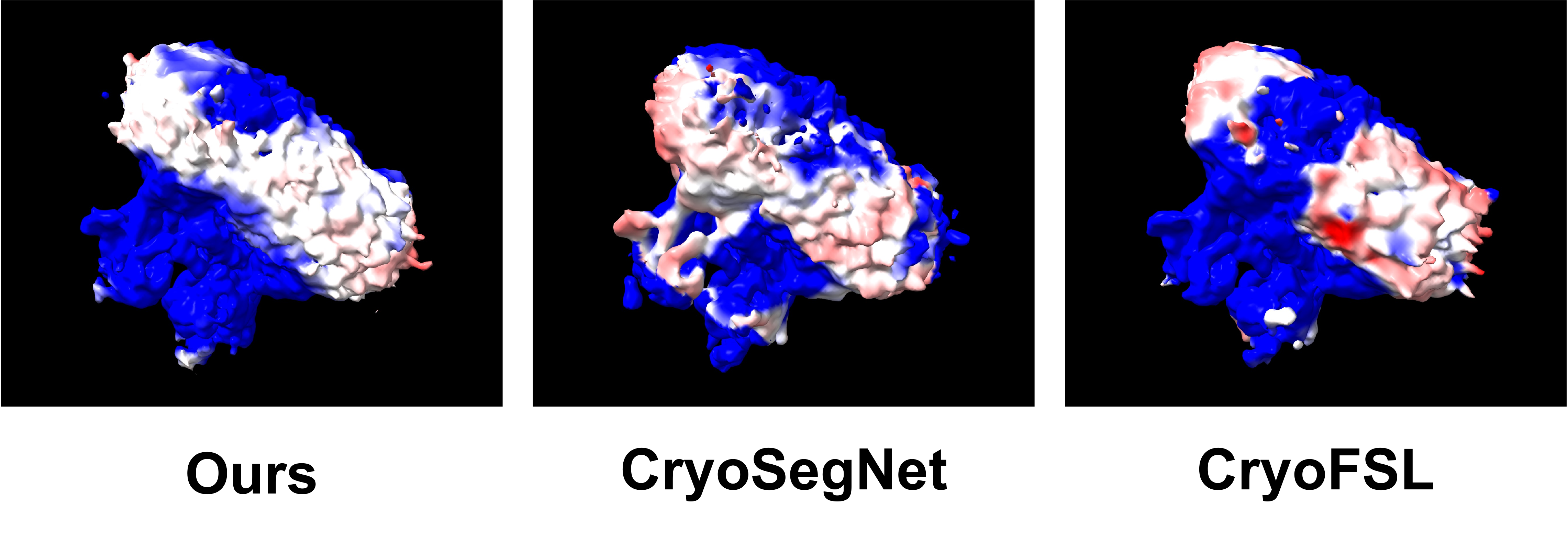
Local resolution maps of the full-set 3D reconstructions on EMPIAR-10081 for CryoAnomaly, CryoSegNet, and CryoFSL. Blue indicates finer local resolution, whereas red indicates coarser local resolution. Median local resolution values are annotated on each panel.